Edfrank Custom Jewelry
Edfrank Custom Jewelry is the small, handcrafted jewelry business founded by Frank Frink and Ed McCarthy in San Francisco, producing original contemporary metalwork that stands in deliberate contrast to the forged historic artifacts of W-M Corporation. Its pieces, especially the silver triangle later purchased by Nobusuke Tagomi, become the novel's central symbol of authentic creation and the possibility of a new American art.
Founding and Early Operations
The business was conceived in the aftermath of Frank Frink's firing from W-M Corporation, where he had spent fifteen years producing forgeries of pre-war American artifacts, specializing in Colt revolvers of the Frontier period. Ed McCarthy, the shop foreman, urged Frink to try original designing, challenging him with the accusation that he had "picked up the Nazi idea that Jews can't create." After consulting the I Ching and receiving Hexagram Eleven, Peace, with the judgment "The small departs. The great approaches. Good fortune. Success," Frink agreed to the venture. McCarthy then revealed his plan to quit and join Frink, contributing his own designs. The two men obtained two thousand dollars from Wyndam-Matson, which Frink recognized as a form of blackmail, and set up their workshop in the basement of Frink's building. They named the business Edfrank Custom Jewelry, a combination of their names, and printed business cards using an artgun eraser carved to form their name, completed with a children's toy rotary printing set on high-quality Christmas-card colored heavy paper.
The Workshop and Craftsmanship
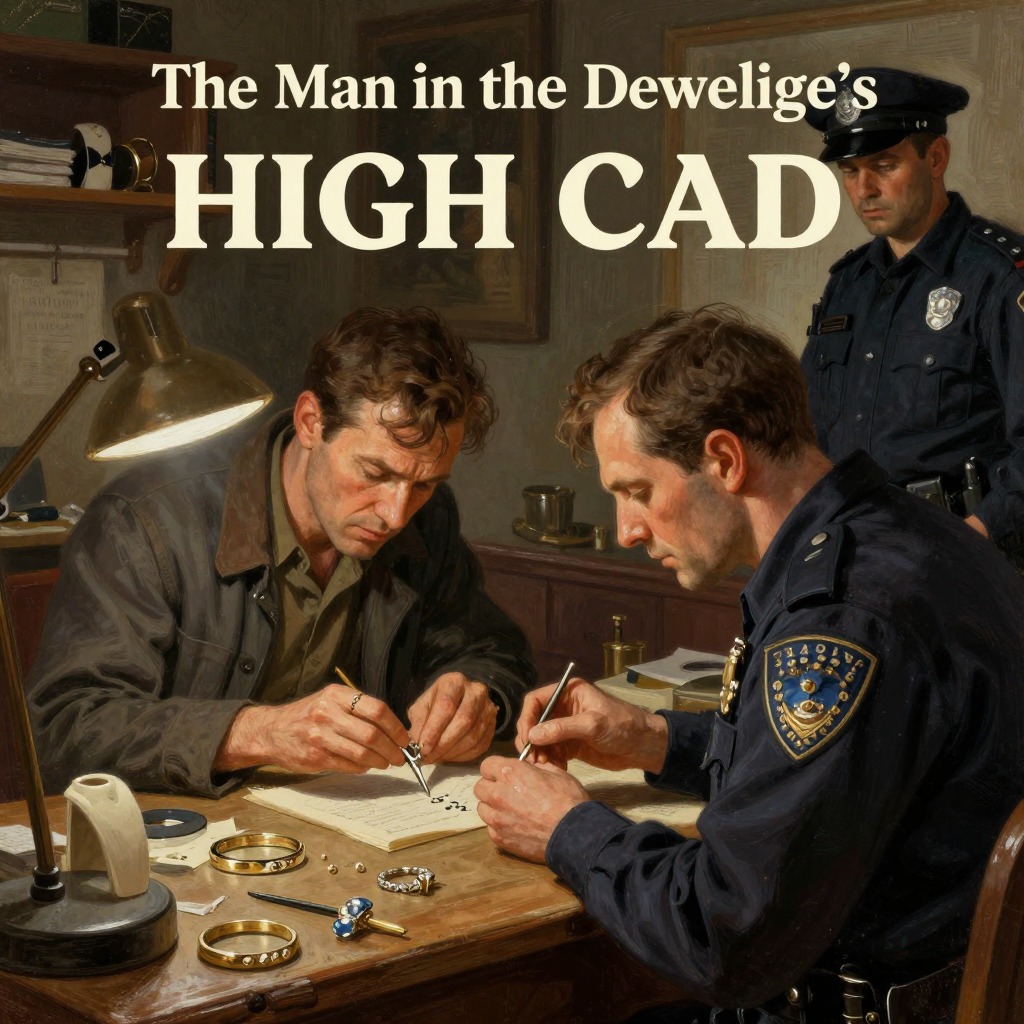
The basement workshop was equipped with a bench, motors, a flex-cable machine, and an arbor of grinding and polishing wheels, along with a complete range of finishing tools from coarse wire brushes through Cratex wheels to finer polishing buffs of cotton, linen, leather, and chamois. They had an oxyacetylene welding outfit with tanks, gauges, hoses, tips, and masks, plus superb jewelers' tools including pliers from Germany and France, micrometers, diamond drills, saws, tongs, tweezers, and hand-forged tiny hammers. Over half of the two thousand dollars was spent on equipment and supplies, leaving only two hundred and fifty dollars in their Edfrank bank account. Their first finished batch, produced after two weeks of nearly constant work, lay on two boards covered with black velvet in a square wicker basket of Japanese origin. The pieces included cuff bracelets made of brass, copper, bronze, and hot-forged black iron; pendants mostly of brass with a little silver ornamentation; earrings of silver; and pins of silver or brass. They had also bought semiprecious stones—baroque pearls, spinels, jade, and slivers of fire opal—and planned to try gold and possibly five- or six-point diamonds if things went well. Their quality control was excellent; the slightest dullness or wire brush scratch was enough reason to return a piece to the shop.
The First Selling Attempt
Ed McCarthy approached Robert Childan's store, American Artistic Handcrafts Inc., first, since Childan would certainly remember Frank Frink from the fake admiral incident. McCarthy, wearing a new suit, tie, and white shirt, carried the wicker hamper into the store. Childan initially dismissed the jewelry, saying "No thanks. Not in my line," but after McCarthy persisted, Childan allowed him to lay out the pieces. Childan picked out several pieces, leading McCarthy to believe he was buying, but then offered only a consignment arrangement, with the store taking two-thirds of the proceeds when pieces sold and assuming no liability for theft or damage. McCarthy, having spent over an hour showing his wares and with all his displays disarranged, reluctantly agreed. Childan kept the selected pieces and gave McCarthy a signed tag listing the items, telling him to call in a month or so. When McCarthy returned to the truck, Frink could tell it had not gone well. "He didn't say no," McCarthy said, but "Consignment." Frink was incredulous: "You let him? We talked it over—" They sat together silently in the truck for a long time.
The Silver Triangle and Its Significance
Despite the disappointing consignment deal, Childan recognized the quality of the jewelry, noting "Certainly not amateurs," and planned to mark up the prices and push the handmade angle. He also saw a strategic advantage: "With these, there's no problem of authenticity." He decided to graft the best piece to Betty Kasoura, but Paul Kasoura intercepted the gift. Paul studied the pin and delivered an extraordinary meditation on it, declaring that it had "wu"—a Chinese concept of wisdom or comprehension—rather than wabi or historicity. He explained: "The hands of the artificer had wu, and allowed that wu to flow into this piece. It is complete, Robert. By contemplating it, we gain more wu ourselves." Paul returned the pin, insisting that Childan assume moral responsibility for the jewelry, and revealed that an importer wanted to mass-produce the designs as good-luck charms for Latin America and the Orient. Childan, after a moment of humiliation, rejected the offer, declaring "I am proud of this work. There can be no consideration of trashy good-luck charms. I reject." Paul then apologized, and they shook hands.
Later, Nobusuke Tagomi visited Childan's store, seeking to trade in his Colt .44 revolver, which carried too much subjective history after he had used it to kill two SD men. Childan refused the trade but showed Tagomi the Edfrank jewelry, saying "This is the new life of my country, sir. The beginning in the form of tiny imperishable seeds. Of beauty." Tagomi, skeptical but grasping at straws, agreed to buy one piece, and Childan selected a small silver triangle ornamented with hollow drops, black beneath and bright and light-filled above. Tagomi took the silver triangle to Portsmouth Square, where he sat in the sun and contemplated it intensely, trying to extract meaning from it. He shook it, breathed on it, held it to his ear, smelled it, tasted it, and finally experienced a vision of the object as "Body of yin, soul of yang. Metal and fire unified." The vision was interrupted by a policeman who mistook the triangle for a child's puzzle, and Tagomi, disoriented, wandered through a distorted world before recovering. He later clutched the silver triangle as he suffered a heart attack, thinking "Did not save me, he thought. Did not help. All that endeavor."